The reproducibility illusion 🧪 Link to heading
You committed your code to GitHub ✅
You wrote a clean README ✅
You even tagged a release 🎉
Six months later, someone clones your repo and nothing runs 💀
If that sounds dramatic, it is only because it is so common in computational biology. The code is still there. The analysis logic is still there. But the environment that made it all work has quietly drifted out from under you.
A Seurat update here. A Matrix breaking change there. A transitive dependency you never even knew about gets bumped, and suddenly your pipeline is dead on arrival 💥
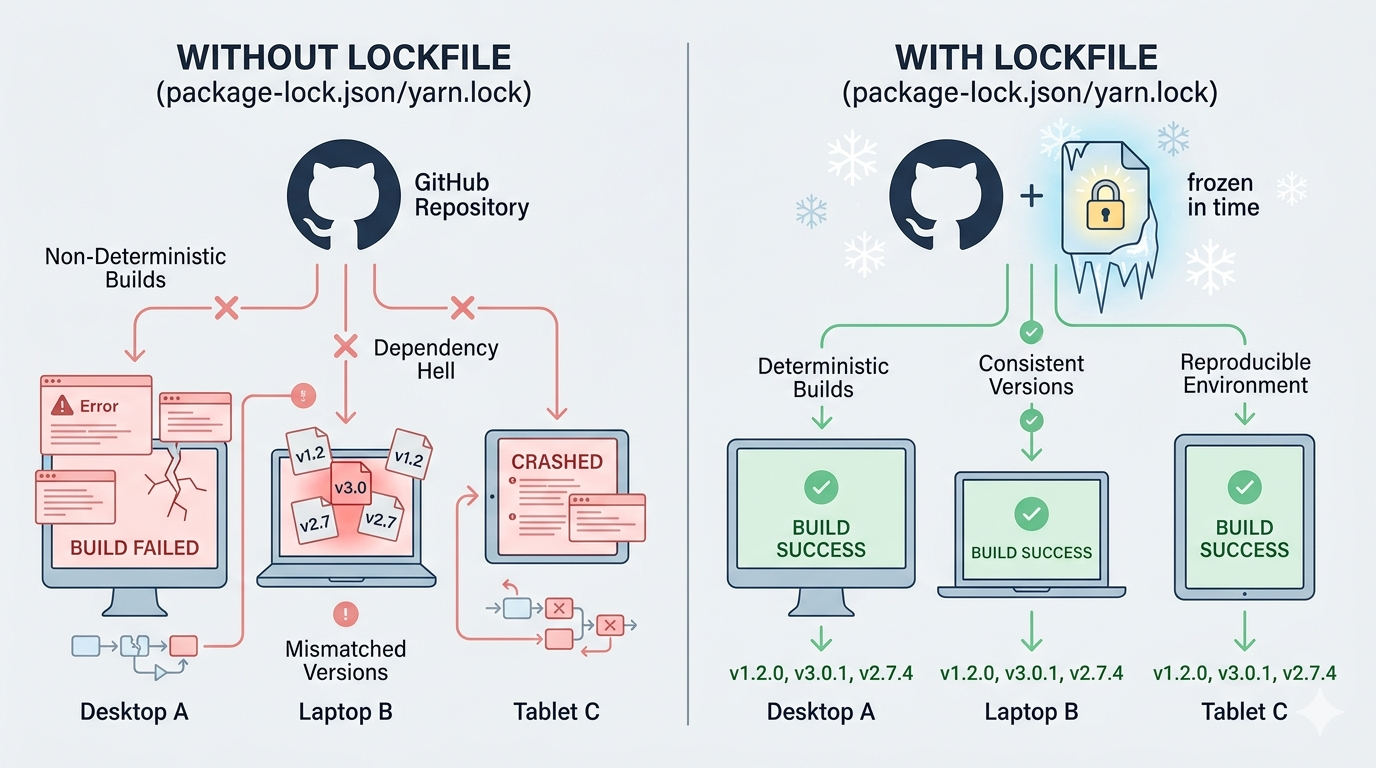
That is the reproducibility illusion: version control makes you feel safe, but source code only preserves part of the story.
Source code is only half the story 📖 Link to heading
Your repository captures the logic of the analysis. It tells us what you meant the code to do.
What it does not capture is the exact computational environment that made the code executable in the first place:
- package versions
- dependency resolution
- runtime versions
- ecosystem state at the moment the project actually worked
That missing layer matters because packages change constantly ⚡
In bioinformatics, that change compounds fast. Pipelines run for years. Papers get revisited. Reviewers ask for re-analyses. Collaborators try to rerun your workflow on another machine, another server, or another operating system.
Without environment capture, “I used DESeq2” is not really an answer 🤷
Was it DESeq2 1.38 or 1.42?
Which Bioconductor release?
Which version of R?
Which supporting packages were resolved alongside it?
Those details are the difference between reproducibility and archaeology.
Enter the lockfile 🔒 Link to heading
A lockfile is a frozen snapshot of your entire dependency tree 🧊
Not just the packages you asked for directly, but every dependency of every dependency, pinned to exact versions 📌
- In Python, that is
uv.lock⚡ - In R, that is
renv.lock📊
Both answer the same question:
What exact environment made this code work?
That is the core job of a lockfile. It turns environment setup from guesswork into something explicit, inspectable, and recoverable.
Why this matters so much in bioinformatics 🧬 Link to heading
This problem hits especially hard in research computing because our work has a long memory.
- Pipelines often stay relevant for years 🕰️
- Manuscripts come back during revision 📰
- Results need to be checked or extended later 🔄
- Collaborators may rerun the same analysis far from the original machine 🌍
When you revisit a project months later, the code may still look perfectly reasonable. What changed is the ecosystem around it.
That is why lockfiles are not a luxury. They are part of the minimum reproducibility stack.
If Git captures your code, the lockfile captures your environment. You need both for the work to remain runnable.
Code captures logic. Lockfiles capture environment. 🏗️ Link to heading
I think this is the distinction many researchers miss.
Git and lockfiles solve different problems:
- Git: tracks how your source code changes over time
- Lockfiles: track the exact resolved environment that source code depended on
One tells you what you wrote.
The other tells you what made it run.
Real reproducibility requires both ✨
Containers can take this one step further by pinning system libraries and the operating system too. But even before Docker or Singularity enter the picture, a lockfile gives you a massive upgrade in reliability.
It is the simplest reproducibility habit with one of the highest payoffs.
The big convergence 🤝 Link to heading
What is especially interesting right now is that R and Python are converging on the same basic idea.
Python’s uv has set a new bar for fast, declarative, cross-platform environment management 🦀
R has had renv for a while, and now newer tools like rv and uvr are pushing the ecosystem toward the same philosophy ⚡
The details differ. The ergonomics differ. The ecosystems definitely differ.
But the direction is the same:
- environments should be explicit
- dependencies should be reproducible
- project setup should not depend on vague memory or luck
That convergence matters because it reflects a broader cultural shift. Reproducibility is no longer something we bolt on after the fact. It is becoming part of the normal shape of good computational work.
Why you should start now 🚀 Link to heading
If your project has dependencies, it should have a lockfile.
That applies whether you are building a one-off analysis, a long-lived pipeline, an R package, or a Python workflow that will eventually support a paper.
The practical rule is simple:
- commit your code
- write the README
- keep the lockfile
Do all three, not just the first two.
Because when someone asks, “What exact setup made this result work?”, the right answer should not be “I think it was this package version?” 😅
The answer should be in the file 💎
What is next 👀 Link to heading
This post is the conceptual foundation.
Next up: uv.lock vs renv.lock.
I will break down what each one captures, where they differ, and how the R ecosystem is evolving to close the gap with Python’s new generation of tooling.
The era of “it worked on my machine” is dying 💀
Lockfiles are one of the things killing it 🔥